Why Only Certified Repair Shops Should Handle High-Tech EV Collisions
Tesla vehicles are computers on wheels. They use lightweight aluminum and gigacast structures, high‑voltage batteries, and a constellation of cameras and sensors to support Autopilot and Full Self‑Driving. That sophistication gives them a high resale value when everything is intact. Unfortunately, the moment Carfax records a collision, the value of even a perfectly repaired vehicle drops (kbb.com). In the luxury market, more than half of buyers refuse to consider a vehicle with an accident history, and roughly 75 % demand a significant discount. You can’t erase an accident, but you can control how your Tesla is repaired. The following guide explains why certified OEM repairs are the best defence against diminished value and how to navigate insurance and repair decisions.
Why Carfax Reports and Diminished Value Matter to Buyers?
Services such as Carfax and AutoCheck compile police, insurance and repair records. Once Carfax or AutoCheck records a collision, the incident becomes part of the vehicle’s history. This transparency benefits used‑car buyers but penalizes sellers. Reporting any accident, however minor, reduces market value (kbb.com). Even when a repair restores the vehicle to pre‑accident condition, the accident remains in the report, which permanently lowers resale value.
-
Buyers pay less for cars with a history of damage. Collision‑repair specialists note that inherent diminished value exists because used‑car shoppers see the accident record and bid lower. According to Kelley Blue Book, cars with clean histories usually command a higher price than similar models with accidents. As a result, sellers must either accept a lower offer or wait longer for the right buyer.
-
Poor repairs compound the loss. Repair‑related diminished value occurs when a shop uses non‑OEM parts or mismatched paint. Buyers can spot misaligned body panels and overspray; these cues signal that a shop cut corners and further erode confidence. For Teslas equipped with sensitive sensors and cameras, miscalibration can also affect Autopilot functions, making potential buyers even more cautious.
Premier Coach’s research calls this the Carfax effect. Once a collision is on record, you can never market the vehicle as accident‑free, and even minor incidents lead to lower offers. Luxury buyers are particularly discerning: about 75 % require a discount before they will consider a high‑end vehicle with an accident history. While you cannot change the record, insisting on proper repairs and documentation helps reduce how much value you lose.
Why OEM Parts Matters?
Tesla builds Original Equipment Manufacturer (OEM) parts to the same specifications as the components installed at the factory. These parts fit precisely, integrate with sensors and software, and carry Tesla’s warranty. Aftermarket parts often cost less, but they seldom meet the same standards.
The following table summarizes why OEM parts are crucial:
| Benefit of OEM parts | Evidence |
|---|---|
| Maintain structural integrity and fit | Certified collision centres use parts designed for your car’s exact specifications. Panels align correctly, and ADAS sensors remain calibrated, preserving crash performance. |
| Preserve warranty | Non‑certified repairs can void Tesla’s warranty. Heritage Body & Frame warns that getting your Tesla fixed at a non‑certified body shop jeopardizes warranty coverage.. Using genuine parts keeps the warranty intact. |
| Protect resale value | Vehicles repaired with OEM parts typically retain higher resale value than those repaired with aftermarket alternatives (mymeridianinsurance.com). Certified collision centres ensure repairs match the original design and finish, giving future buyers confidence. |
| Avoid repair‑related diminished value | Non‑OEM parts and poor workmanship further devalue a vehiclenorthsidecollisionsa.com. OEM components minimize this risk by ensuring fit, finish and compatibility. |
Aftermarket parts can be 25–75 % cheaper, but that savings comes with trade‑offs. Misaligned body panels, mismatched paint and non‑calibrated sensors degrade both safety and aesthetics. Over time, corrosion and premature wear can cause additional repairs. Because EVs like Tesla rely on integrated electronics and advanced materials, using genuine parts is essential for long‑term reliability and value.
Why Tesla Repairs Need Certified Expert Repairs?
-
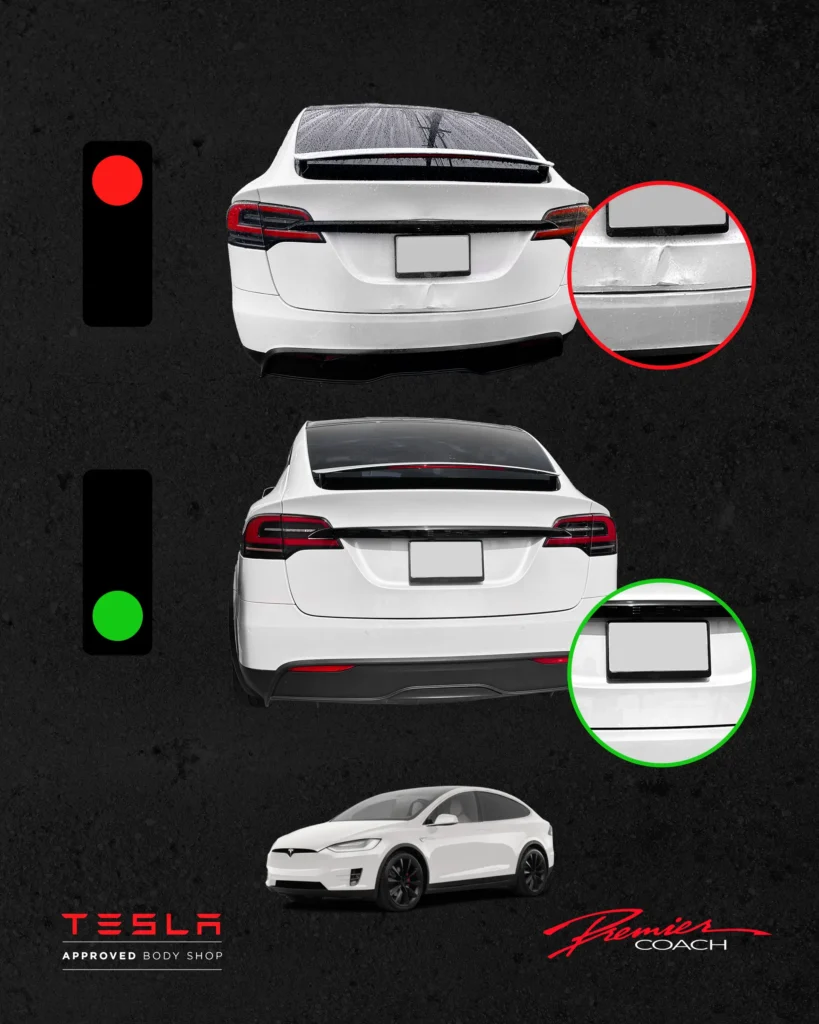
- Tesla Model X Rear End Collision Damage Before and After by Premier Coach Auto Collision Tesla Approved Body Shop Auto Collision in Thousand Oaks and Camarillo
-
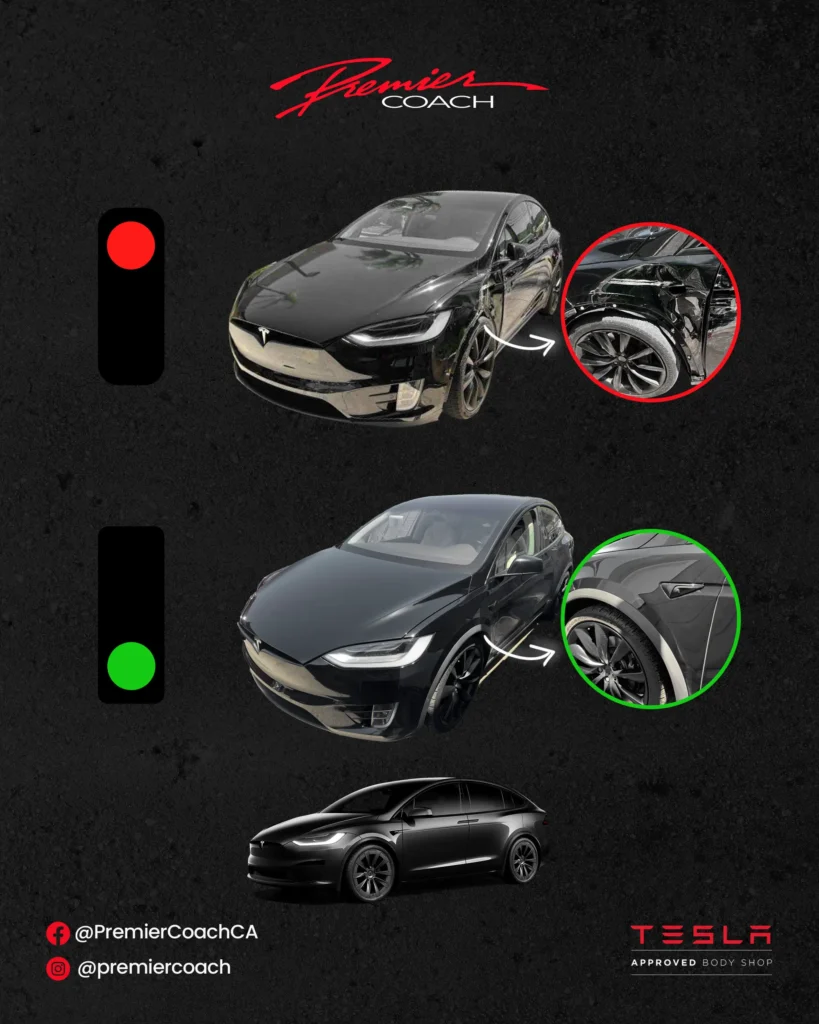
- Tesla Model X Fender Collision Damage Before and After by Premier Coach Auto Collision Tesla Approved Body Shop in Thousand Oaks and Camarillo
-
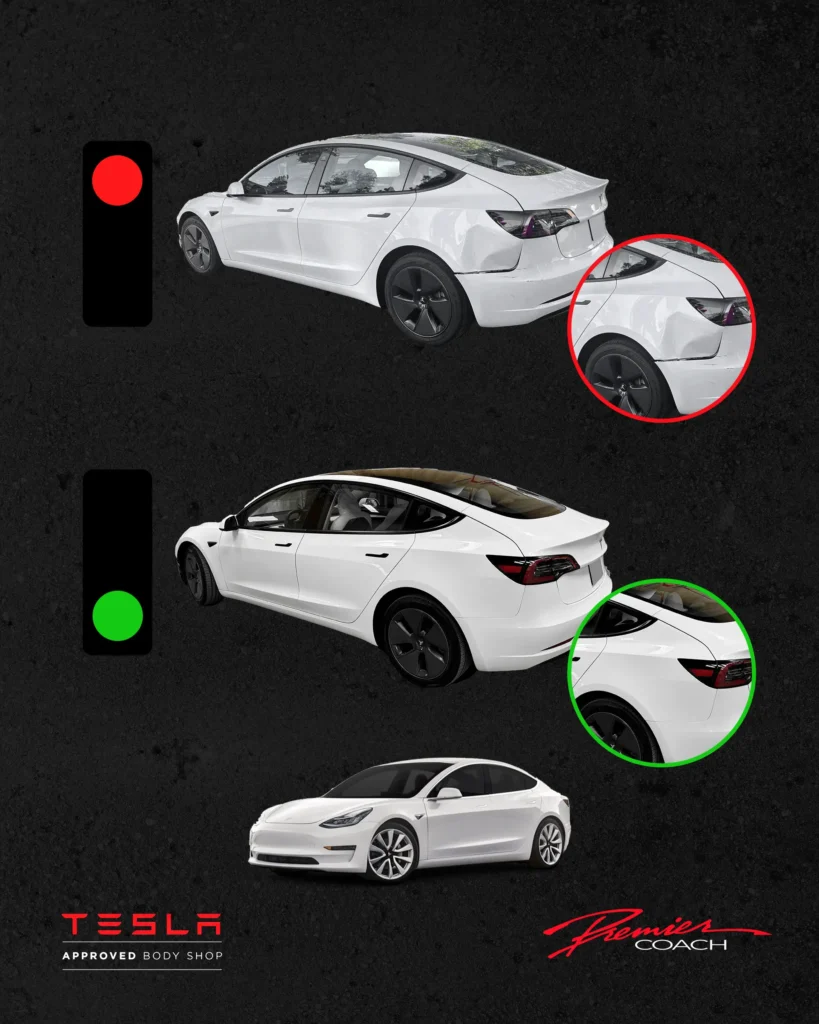
- Tesla Model Y Quarter Panel Collision Damage Before and After by Premier Coach Auto Collision Tesla Approved Body Shop Auto Collision in Thousand Oaks and Camarillo
Tesla’s engineering goes far beyond conventional vehicles. Its vehicles use high‑voltage batteries, lightweight aluminum bodies, stainless‑steel panels, gigacasting and an array of ADAS sensors. Repairing these systems requires more than traditional bodywork.
-
Specialized training and equipment. Tesla‑certified technicians receive rigorous training in handling high‑voltage systems, aluminum and stainless‑steel welding, and sensor calibration. Certified shops invest in factory‑approved tools for battery isolation, gigacast replacement and ADAS calibration.
-
Genuine parts only. Tesla prohibits the use of recycled or aftermarket components, Certified collision centres install new OEM parts to restore structural integrity and sensor alignment. This practice ensures that high‑strength materials and safety systems perform as designed.
-
Warranty and software support. Tesla communicates directly with certified shops, providing repair procedures, software updates and technical guidance. Non‑certified repairs risk voiding your warranty and disabling over‑the‑air software services.
-
Complexity drives up costs. The CCC Crash Course report shows that increasing vehicle complexity and rising labour costs are raising repair expenses. Newer vehicles often require part replacement rather than repair, and the cost differential for repairing newer models has grown by 35 % over the past decade. Certified shops factor this into their estimates, ensuring the proper parts and procedures are used.
Because modern Teslas integrate structural, electrical and software systems, uncertified repairs can lead to battery damage, sensor misalignment or software restrictions. Performing repairs to factory standards preserves both safety and resale value.
Why Going Cheap on Insurance Estimates Isn’t Always Wise?
After a collision, insurers typically generate an estimate using standardized software. These quick assessments often omit regional labour rates, current parts prices and hidden damage. Here is what the data tell us:
-
Virtual estimates miss hidden damage. Studies show that over 70 % of photo‑based insurance estimates require supplements once the shop conducts a detailed teardown. Hidden structural damage or sensor misalignment only becomes apparent during an in‑person inspection.
-
Insurers favour cheaper parts. Many insurance companies recommend aftermarket or recycled components to lower costs. While these parts may be less expensive up front, they often don’t fit correctly and can lead to further repairs or warranty issues. Using OEM parts protects your car’s integrity and value.
-
Labour rates differ. Insurers often base labour costs on discounted rates from direct‑repair networks, whereas certified shops charge market‑based rates that reflect specialized training and equipment. Understanding this gap helps you challenge an artificially low estimate.
-
Supplements are common. CCC’s industry analysis reports that about 63 % of collision repairs require at least one supplemental claim, with an average gap of $1,200–$1,800 between the insurer’s initial estimate and the final approved cost. This difference reflects hidden damage and the cost of proper parts.
-
OEM coverage protects you. Adding an OEM parts endorsement to your policy ensures that repairs use high‑quality components, maintain your warranty and preserve resale value (mymeridianinsurance.com).
To visualize these trends, the bar chart below summarizes key statistics on buyers’ expectations, insurance estimates and repair costs.
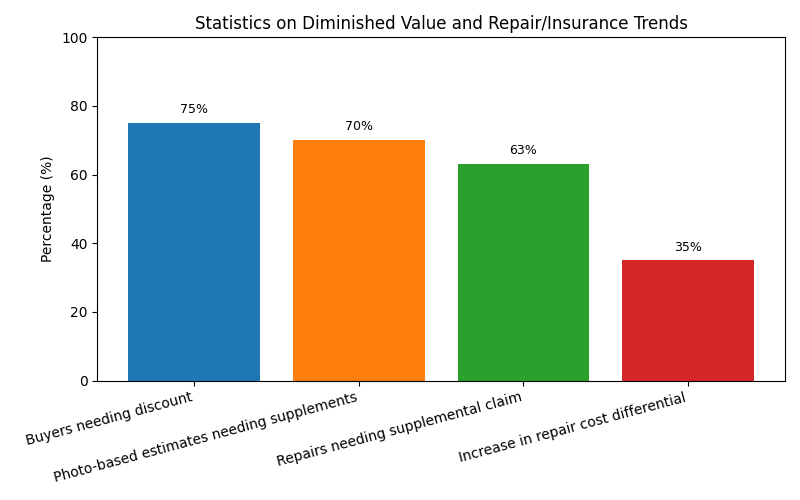
The graph highlights that buyer discount expectations (75 %), virtual estimate supplements (70 %) and supplemental claims (63 %) far exceed the 35 % increase in cost differential over the past decade. These numbers underscore why cutting corners on repairs or accepting the lowest estimate can cost you more in the long run.
Steps to Protect Your Tesla’s Value After a Collision
-
Choose a Tesla‑certified or manufacturer‑approved body shop. Only certified centres have access to genuine parts, factory‑level equipment and Tesla’s repair procedures. Their technicians undergo training to handle high‑voltage systems and calibrate sensors accuratelyIf you’re in Southern California, Premier Coach’s Tesla‑certified collision centre can provide this level of care.
-
Insist on OEM parts. Require your insurer and repair shop to use genuine Tesla parts. Document every part used, and keep receipts to show that the shop installed OEM components. This helps maintain performance, safety and resale value.
-
Get a thorough teardown and diagnostic scan. Don’t rely on a photo estimate. A detailed inspection reveals hidden structural or electronic damage and ensures the repair quote reflects all required work. A full diagnostic scan is especially important for Teslas because cameras and sensors must be recalibrated.
-
Document everything. Keep copies of the accident report, photographs, repair bills and communication with the shop and insurance company. Transparency builds trust with future buyers and may support a diminished value claim
-
Consider a diminished value claim. If another driver caused the accident, you may be eligible for compensation for your vehicle’s decreased value. A professional appraisal can quantify the loss.
-
Advocate for OEM coverage in your insurance policy. Many insurers offer endorsements that guarantee OEM parts. These policies ensure that your car is repaired using high‑quality components, protect your warranty and preserve resale value.
How Premier Coach Auto Collision Can Help
Premier Coach Auto Collision restores Teslas to factory specifications as a Tesla‑certified collision centre. Our technicians undergo extensive training in high‑voltage systems, ADAS calibration and advanced materials. We use only Tesla Genuine Parts and adhere strictly to Tesla’s repair manuals. This approach ensures your vehicle’s safety, retains software support, and protects your warranty. In addition to Tesla, we are certified to repair BMW, Mercedes‑Benz and other luxury brands.
Our insurance claim assistance service bridges the gap between what your insurer will pay and what your vehicle truly needs. We handle paperwork, communicate with the adjuster and advocate for OEM parts, ensuring that your repair follows factory standards. We also offer auto body repair and collision repair services backed by a lifetime warranty.
Final Thoughts
An accident doesn’t have to ruin your Tesla’s value. Choosing a certified body shop and insisting on OEM parts will minimize diminished value, preserve performance and keep your warranty intact. Proper documentation and an OEM parts endorsement on your insurance policy provide additional protection. By following these steps, you can maintain your Tesla’s desirability in the used‑car market and safeguard your investment. Premier Coach Auto Collision is ready to help you navigate the repair process, work with your insurer and restore your vehicle to factory standards.